Best exterior paint colors for Arizona heat: what actually holds up in the Phoenix sun
Choosing the best exterior paint colors for Arizona heat comes down to two things a national color guide never mentions: how much sun a color reflects, and how well it hides fade once the Phoenix summer gets to it. You already know the desert punishes a paint job. What most homeowners don't know is that the color itself decides whether the finish looks tired in five years or still holds at ten. After quoting exterior repaints across the Valley, here is how I steer people toward colors that survive our sun instead of fighting it. Novak Painting Group is bonded and insured, owner Cody Novak walks every job and does the color work himself, and the estimate is free.
Best exterior paint colors for Arizona heat: lighter, warmer, and desert-muted
The best exterior paint colors for Arizona heat are light-to-mid warm neutrals: greige, warm white, sandy tan, soft taupe, and muted clay. They reflect more of the sun's energy instead of soaking it in, they hide UV fade because there is less pigment to lose, and they read as intentional desert-modern rather than fighting the landscape. Deep charcoals, navies, and saturated earth tones absorb heat and show fade first. That is not an aesthetic opinion, it is what the west wall does to them after a couple of Phoenix summers.
Why color is a heat decision here, not just a style one
Color choice here is really a heat-management decision as much as a style one. A wall's surface can run far hotter than the air temperature in direct summer sun, and darker colors push that surface temperature higher, which stresses both the coating and the stucco underneath.
In Phoenix the color you pick is a thermal decision, not just a taste one. A dark wall doesn't only look hotter, it runs hotter, and the paint film pays for it first.
Desert-modern palettes that hold up here
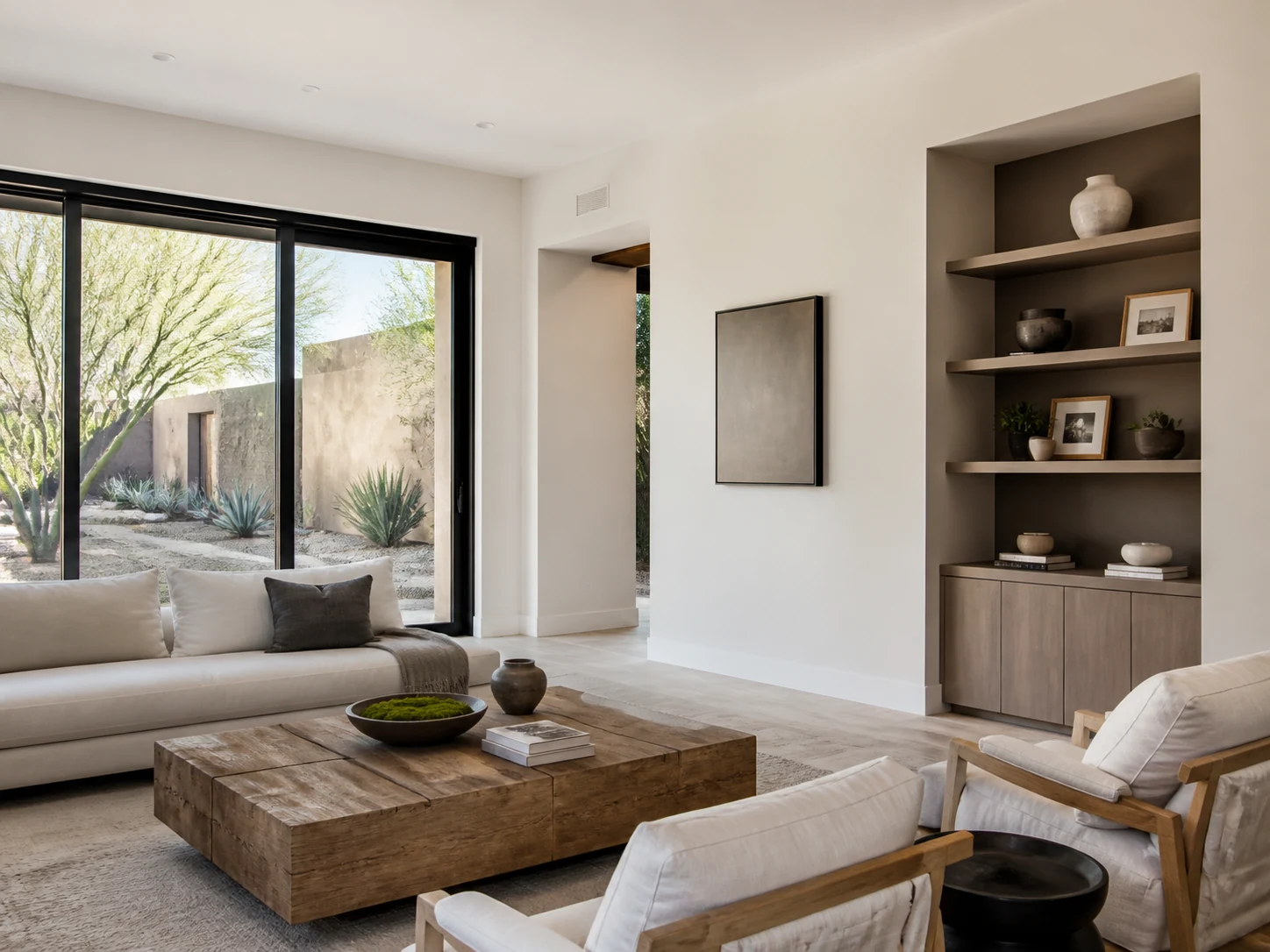
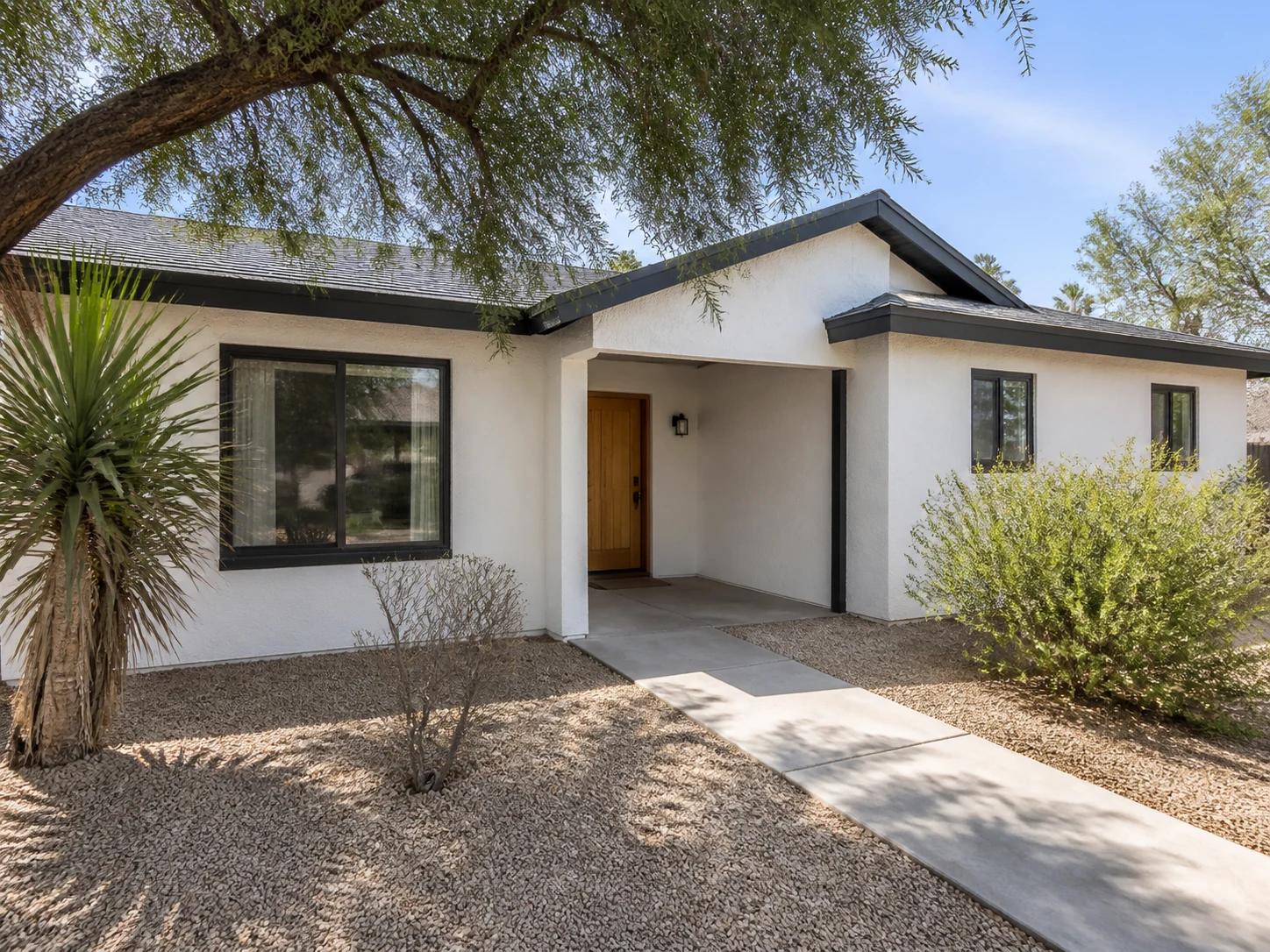
- Warm greige body with warm-white trim. The default for a reason. It reflects heat, hides dust, and pairs with almost any roof and stone.
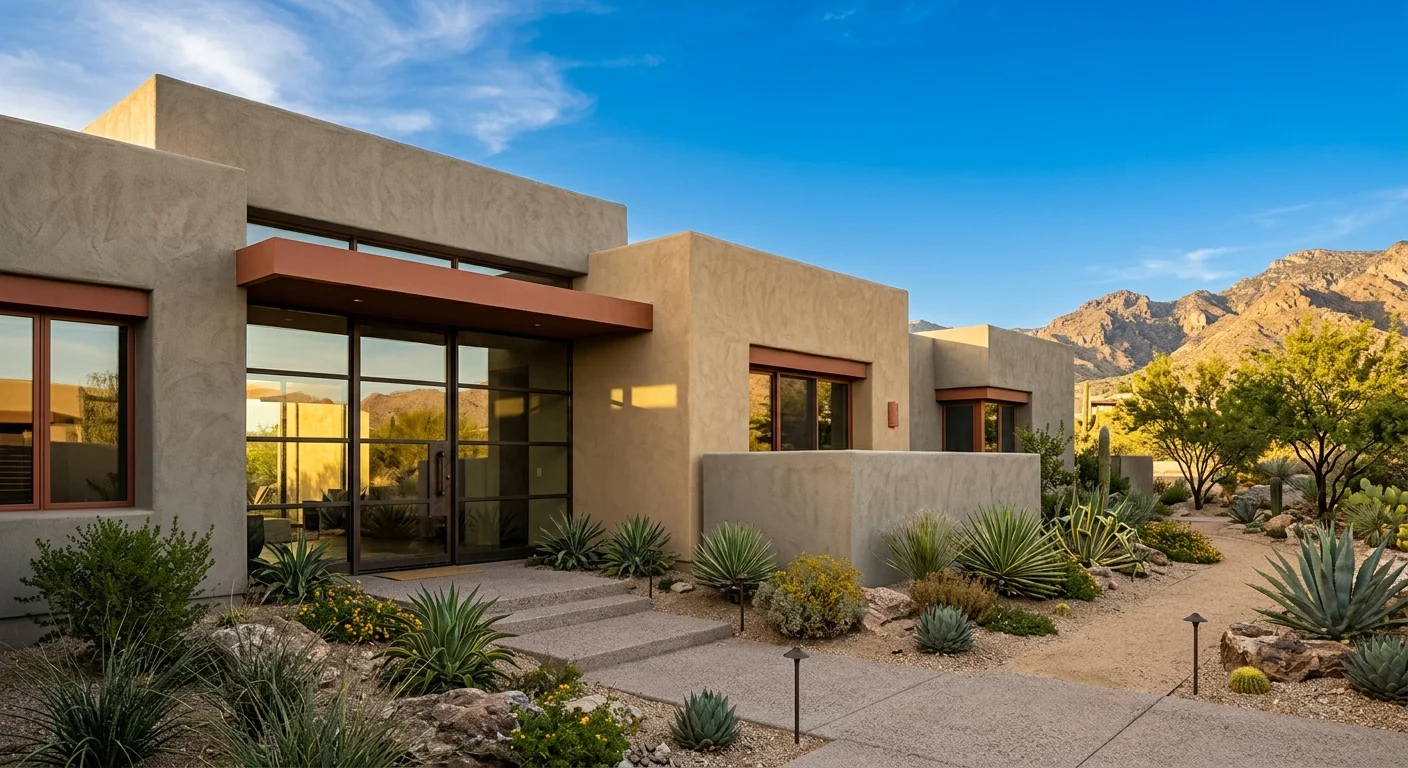
- Sandy tan body with a deeper clay or terracotta accent door. Keep the saturated tone on the small accent, not the big sun-facing walls, so the fade-prone color is doing the least sun-facing work.
- Soft taupe with bronze or dark-bronze metal accents. Reads contemporary, and the dark is confined to metal that can take the heat rather than a full stucco elevation.
- Warm white with a low-contrast greige trim. Brightest and coolest option, common on desert-contemporary customs in Scottsdale and Paradise Valley, and it hides monsoon dust surprisingly well.
If you are choosing inside an association's palette, those approved lists usually already skew this direction, and there is a whole separate playbook for getting a scheme through the committee. I walk through that in the guide to HOA approved exterior colors in Phoenix, so this post stays focused on the heat and fade side of the decision.
Heat reflective exterior paint colors and what LRV actually tells you
Heat reflective exterior paint colors are the lighter ones, and the number that tells you how light is LRV, or Light Reflectance Value, printed on nearly every fan deck from 0 (black) to 100 (pure white). A higher LRV reflects more visible light and, generally, more solar heat, so a wall stays cooler and the coating ages slower. For a big Phoenix exterior body color in full sun, I steer homeowners toward roughly the 55 to 75 LRV range: light enough to reflect real heat, deep enough to still hide dirt and not glare white.
LRV is a guide, not a hard rule, and there are real trade-offs at both ends. Go too high and a bright white can glare uncomfortably in Phoenix's intense midday light and show every speck of dust. Go too low and you are back to a heat-soaking wall that fades first. The sweet spot for most Valley homes sits in that upper-middle band, which happens to be exactly where the warm desert neutrals live.
How I use LRV when narrowing a scheme
- Body color: aim mid-to-high LRV. Roughly 55 to 75 for a big sun-facing exterior, so the largest surfaces reflect the most heat.
- Trim: keep it close to the body. Moderate contrast weathers more evenly than a stark light-on-dark scheme where one element fades against the other.
- Accent and doors: this is where a lower-LRV color is fine. A deep front door is small, often shaded by an entry, and easy to refresh on its own later.
- Check the actual wall, not the chip. A greige that reads neutral indoors can go pink or green in Phoenix afternoon light. Tape a large sample up and look at it midday and again near sunset.
Colors that don't fade in the Arizona sun (and why some fade fast)
No color is truly fade-proof under Phoenix UV, but the colors that hold their look longest are light, warm, and low-saturation, applied in a quality UV-resistant coating over proper prep. Fade is really pigment loss: ultraviolet radiation breaks down the resin binders holding pigment in the film, the pigment lifts off as a fine chalk, and the color drifts. A color with less pigment to lose, and a lighter starting point, simply has less distance to fall before you notice.
Reds, deep blues, and bright earth tones are the ones I watch fade hardest here. The organic and some synthetic pigments behind those colors surrender to UV faster than the earth-oxide pigments in tans, greiges, and clays.
The pigment chemistry is the quiet reason desert neutrals win twice. Tans, warm whites, and clay tones are built largely on iron-oxide and earth pigments that are naturally UV-stable, so they both start lighter and hold their color longer. The vivid reds, purples, and some bright blues lean on pigments that photodegrade faster, which is why a bold accent can look sun-tired while the neutral body next to it still reads fresh. Whatever color you land on, the fade timeline still depends on prep and coating quality, which is the part our professional exterior painting in Phoenix is built around: clean off the chalk, prime the bare spots, and spec UV-resistant coatings on the exposed south and west elevations rather than treating every wall the same.
This is not the color question for every homeowner
Do not overthink a color change if your existing scheme is already a light warm neutral and only one sun-facing wall shows mild fade. You may not need a new color at all, just a recoat in the same family, or even a single-elevation touch-up. Chasing a trendy deep color onto a big west wall in Phoenix is how people end up repainting out of cycle, and talking someone into a dramatic color they will fight the sun over is not how I run. I will tell you that in person before you commit to anything.
Hiding desert dust and monsoon grime with the right color
Phoenix throws a second problem at your color that most guides ignore: dust. Blowing dust year-round and monsoon storms from roughly July through September coat exterior walls in a fine tan film, and the color you choose decides whether that film shows. Very dark walls show dust as a chalky haze. Bright stark whites show every streak and rain-run. The warm mid-tone neutrals hide it best, because our dust is essentially the same warm tan the color already is.
None of this means you have to paint the whole house beige. It means the big sun-facing surfaces are where the warm neutral belongs, and the personality goes into the smaller, more protected elements: the door, the metal, the shaded entry. That is the same logic behind good desert-modern design, and it is why the palettes that photograph well in this climate also tend to be the ones that stay looking good.
Exterior color choices by surface in Phoenix
Here is the quick reference I come back to when a homeowner asks where each color should go. Treat these as Valley-specific starting points, since your sun exposure and existing materials shift them.
| Surface | What works in Arizona heat | What to avoid |
|---|---|---|
| Stucco body (sun-facing) | Warm greige, tan, taupe, roughly 55 to 75 LRV | Deep charcoal, navy, saturated earth tones |
| Trim and fascia | Warm white or low-contrast greige near the body | Stark light-on-dark that fades unevenly |
| Front door and accents | A deeper clay, bronze, or muted color, usually shaded | Bright reds and purples on unshaded surfaces |
| Metal (garage, railings) | Dark bronze or deep tone, handles heat on metal well | Glossy dark on large flat panels that warp |
| Block walls and fences | Match or tie to the body neutral, full-sun rated coating | Anything deep, these sit in unshaded sun all day |
Notice the pattern: the light warm neutral does the heavy lifting on the big sun-facing surfaces, and the color lives on the small, protected pieces. That is how you get a home with real personality that still holds up to a Phoenix summer.
Get the color and the coating right in one job
The best exterior paint colors for Arizona heat only deliver if the prep and the product behind them match. A perfect greige over chalked, unprimed stucco still fails early. When I quote a repaint, I walk every elevation, read how much sun each wall takes, help narrow the palette to colors that will hold, and spec the coating to the exposure. If the walls need crack work first, we handle the stucco painting and repair as one job with one crew so the patch blends into the texture instead of telegraphing through a fresh coat. Bonded and insured, and the estimate is free. Call or text (480) 420-7391 or get in touch and I will come look before I quote.
Frequently asked questions
What is the best exterior paint for stucco in Arizona?
The best exterior paint for stucco in Arizona is a high-quality acrylic or elastomeric masonry coating rated for UV resistance, applied over clean, repaired, and primed stucco. Elastomeric coatings are thicker and bridge hairline cracks, which suits older stucco that moves with the heat, while premium acrylics breathe well and hold color. Just as important as the product is the color and the prep: a light, warm neutral in a UV-resistant coating over washed and primed stucco outlasts a deep color rushed over chalk. At Novak Painting Group we assess the stucco condition on site, repair cracks first, and spec the coating to how much sun each wall takes.
Do lighter colors keep a house cooler in Phoenix?
Yes. Lighter colors reflect more of the sun's energy instead of absorbing it, so exterior walls painted in a high-LRV warm white or greige run cooler to the touch than the same wall in a deep charcoal or navy under Phoenix sun. Cooler walls also age slower, because less surface heat stress means the paint film and the stucco underneath both break down more slowly. It won't replace insulation or shade, but on big sun-facing elevations the color choice makes a real, measurable difference in surface temperature and in how long the finish lasts.
What LRV should I use for an exterior color in Arizona?
For a big sun-facing exterior body color in Phoenix, aim for roughly 55 to 75 LRV, or Light Reflectance Value. That range is light enough to reflect meaningful heat and hide UV fade, but not so bright that it glares in Arizona's intense midday light or shows every speck of dust. Go higher than that on trim or brighter homes, and save the lower-LRV deep colors for small, protected accents like a front door. LRV is printed on most fan decks, so you can compare finalists before you commit.
Which exterior paint colors fade fastest in the Arizona sun?
Deep, saturated, and bright colors fade fastest under Phoenix UV: reds, bright blues, purples, and dark saturated earth tones. Those colors rely on pigments that photodegrade faster, and darker walls also absorb more heat, which accelerates the breakdown of the resin binders holding the pigment in place. Tans, greiges, warm whites, and clay tones fade slowest because they are built largely on UV-stable iron-oxide and earth pigments and start lighter, so there is less color to lose. On any color, fade is worst on the south and west walls that take the most direct summer sun.
What are the most popular exterior paint colors for Phoenix homes?
The most popular and best-performing exterior colors for Phoenix homes are warm desert neutrals: greige, sandy tan, warm white, soft taupe, and muted clay, usually paired with a warm-white or low-contrast trim and a deeper accent on the door or metal. These desert-modern palettes reflect heat, hide blowing dust and monsoon grime, and hold their color far longer than deep or saturated schemes. They also tend to match the region's stone, gravel, and desert landscaping, which is why they read as intentional rather than dated.